The House
Three buildings, one courtyard, one olive at the centre.
Casa Andrea is not one house. It is three, built across two centuries, set down around a single tree. The oldest stones date from the late Kingdom of Naples; the youngest were laid last winter. Between them, an architect's bet — that new walls can speak the same language as old ones, if you ask them politely and use lime.
For three years, two men and their teams worked here. Claudio Monnini, the architect, who divides his time between Milano and Ceglie Messapica, who drew the courtyard before we owned the land. Mario, the mason from down the road, whose hands had been mixing lime since he was twelve. The old casale was sixty square metres and one room. We added two wings around it. We kept the olive that had been there for a hundred years.
The decision that mattered most was the simplest. Don't pretend the new walls are old. Don't pretend the old walls are perfect. Let each one say what it is, in the same vocabulary — local stone, hand-cut openings, lime, the white intonaco of the south. From the courtyard, on a slow afternoon, you no longer remember which volume came first.
What follows is a walk through the three volumes, as we know them now. The order is not architectural. It is the order in which the house reveals itself, if you arrive in the late afternoon, leave your bag in the casale, and let the light do the rest.

Volume i.
Il casale — the old bones
Sixty square metres of stone, watching over the olives since the late Kingdom of Naples. When we found her she had one room and a tired wooden door. The walls were two-foot thick, the floor was packed earth, the vault overhead had held for two hundred years and showed no sign of stopping.
The restoration was not a renovation. We took nothing out we could keep. The stones were re-pointed in lime by Mario, the way his father did it — never cement, never gypsum. The original openings were left where they were, even when it made the new floor plan harder. Claudio Monnini drew around them rather than through them.
Today the casale holds two rooms: the master bedroom under the barrel vault, and the dining hall around the restored fireplace. Nothing more. It is the quietest part of the house, and the warmest in winter.

The master bedroom, under the vault
You sleep here with the original barrel vault four metres above your head, lime-washed white, faintly uneven in a way no plasterboard could fake. The bed faces the arched window that gives onto the older garden. There is a niche cut into the wall on the left, large enough for a book and a glass of water; Mario cut it by hand, the day he understood what we were trying to do.
Three years of work. These hands understood stone. — said by no one in particular, written down later because someone had to.

The hearth that still works
The dining hall closes around the old fireplace. A conical hood in white plaster — the local form, repeated in farmhouses from here to Lecce. A Pietra di Trani lintel, warm-yellow, cut to size on site. Underneath, the built-in panca camino: a stone bench, two cushions wide, where the children sit in winter while the adults pretend not to want their place.
It draws cleanly. We tested it with a small fire in March, after the chimney had cured for two months. The smoke went up. We ate cured almonds and drank Negroamaro on the bench. The room did the rest.

Volume ii.
The sleeping wing — three suites, one olive
The second volume is the newest in years and the most invisible. It is single-storey, white-intonaco, set perpendicular to the casale, and it bends gently in the middle to avoid the centenary olive at its end. The tree was here long before the wall. Claudio drew the curve over a coffee, in twenty minutes, the day we agreed not to move the roots.
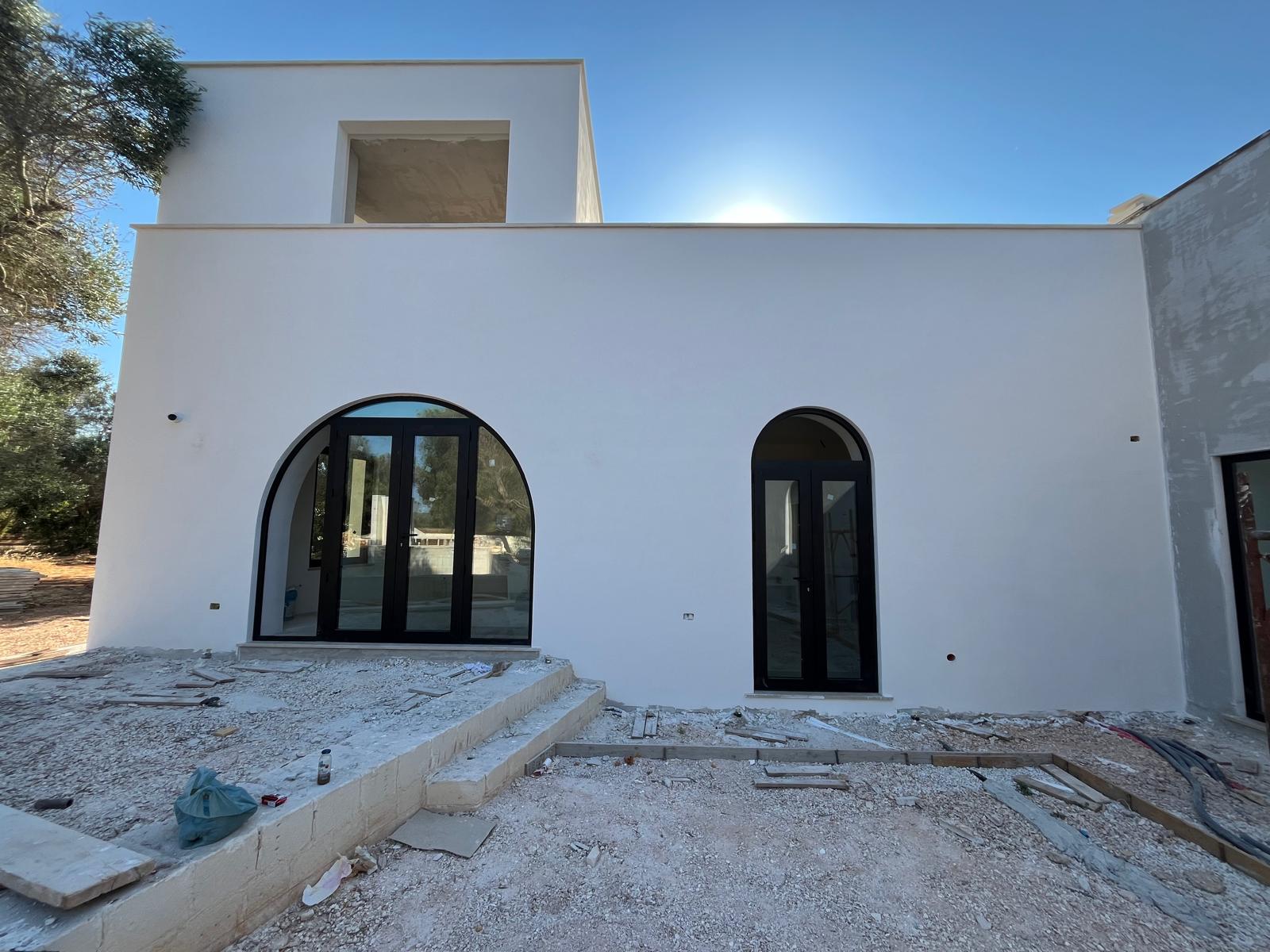
Three arched openings, one for each en-suite bedroom. The arches are not decorative — they repeat the vault of the older bedroom across the courtyard, in a smaller, simpler key. From the inside, each suite reads its arch as a window. From the outside, the wing reads as three doors and a tree.

One of the three suites
Lime-plaster walls, walked over by hand, slightly varied in tone from one to the next. The beams above are lime-washed in the local way, knots showing. A built-in headboard, like the niches in the casale — the wall and the furniture, again, the same thing. A linen curtain rather than a wardrobe door, because Pugliese houses breathe better that way. The window sits low — you can see the olives lying down.

Tadelakt, by hand
The bathrooms are walked in tadelakt — a Moroccan lime-and-soap finish, polished with a river stone and sealed against water. We brought a craftsman from Morocco for a week, then his apprentice for another. Each shower took two and a half days. The colour is not paint; it is in the lime itself.
Walk-in, no door. A bidet in every bathroom, a brass tap, a terracotta floor. The same dimensions across the three suites — no "best" room, no "smaller" room, just three of the same.
Volume iii.
The living wing — the open one
The third volume is the only two-storey building on the estate. Ground floor: an open salon with the kitchen at one end, three glass openings to the courtyard, and a long stone bench against the back wall. Upstairs, the bureau on the roof — windows on both sides, the pool below, the olive grove on the other. There is no corridor between the rooms here. You move by walking through them.
It is the wing where the day happens. The kettle is on at seven. The children find each other on the benches at ten. Lunch sets itself between the kitchen and the terrace because the door is already open. In August we will install a long table under the pergola for the evenings; by September we will probably have moved it twice.

The stone counter
The kitchen counter is a single slab of Pietra di Trani, cut on site by the stonemason in two afternoons, set on a built-in stone base. No cabinets above — only an open shelf, the local way, where the bowls and glasses live in plain sight. The cooktop sets straight into the stone. A drawer underneath for the knives, an oven on the right, the sink looking out to the courtyard.
It will mark with use. We hope it does. A counter that doesn't show a decade of dinners is one that wasn't used enough.

The bureau, on the roof
One staircase, twelve steps, an office above the kitchen. Two windows, both at desk height. North to the olive grove, south to the pool. Starlink overhead — high-speed satellite internet, because at this distance from Brindisi the wired line is not always honest. A desk, a chair, an old map of the Salento on the wall.
It is here for the guest who cannot fully stop. Two hours in the morning, calls when London or New York wakes up, then closed. The advantage of an office that sits five metres above the pool is that it is hard to overstay. The water visible through the window does most of the disciplining.
A walk through, late afternoon, in ten beats.
17:30 — Arrival
You leave the car at the gate, walk thirty metres along the gravel, and the casale appears between the cypresses. White wall, two shutters, the door open.
17:35 — The casale
Cool inside, twelve degrees lower than outside. The vault overhead. You put your bag down on the dining table, by habit. The fireplace stands ready, even in May.
17:45 — Across the courtyard
A door at the back of the dining hall opens onto the courtyard. The centenary olive in the middle, the sleeping wing on the right, the living wing ahead.
17:55 — Your room
A linen curtain pulled back. The bed faces the arched window. The tadelakt shower next door is already cool. You sit on the edge of the bed for two minutes without meaning to.
18:15 — The salon
Three glass openings to the courtyard, all of them folded back. The stone counter holds a basket of figs we left for you.
18:30 — Upstairs, briefly
Twelve steps to the bureau. The pool is below you, the grove behind. You will not open the laptop tonight.
19:00 — The pool
The water is twenty-three degrees. The shadow of the living wing has just reached the deep end. The cicadas slow, then start again.
20:30 — Dinner outside
The long table is laid under the pergola. The bench is from the casale, repainted. The plates are mismatched on purpose. Bread, oil, a Negroamaro from the next village.
22:00 — The courtyard, again
The olive at the centre is lit by one lamp. The three wings are quiet. From here, lying back on a chair, you can see two centuries of stone in a single look.
23:30 — Back under the vault
Cool air through the arched window. The casale stays cooler than the sleeping wing in summer — two-foot walls, two hundred years of practice. You leave the shutters open.
- 5Bedrooms, all en-suite — one in the casale, three in the sleeping wing, the fifth tucked off the salon.
- 10Guests at full house. Whole-house rental only.
- 3Volumes: the 1800s casale, the new sleeping wing, the two-storey living wing with rooftop office.
- ~400 m²Built, roughly, across the three volumes — we have not measured to the centimetre.
- 2 haOf red earth, a hundred centenary olives, a long pool of twelve by four metres.
- 2023 – 2026Three winters of work. Architect Claudio Monnini. Mason Mario and his team.
The house is finishing now. The pool is filling, the kitchen is on, the fireplace draws. If you would like to come and see how three volumes can share one olive, write to us.